

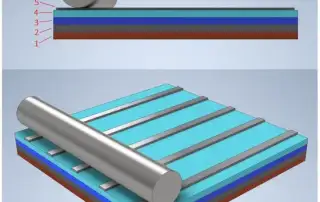
Printability of Collecting Electrode Using AJP for New Construction of Photovoltaic Device
In 2018, the European Parliament and Council laid down a directive about the promotion of the use of energy from renewable sources connected with the Paris Agreement, which sets a global ambition on climate change mitigation through deep and fast cuts in greenhouse gas emissions. Since then, the science world has been even more focused on the development of green technologies such as wind farms, waterpower stations, and photovoltaics as the European Union is preparing to shift to renewables-based energy systems. Each green power technology has its own problems and limitations. Nevertheless, for environmental protection, new power technologies have to [...]
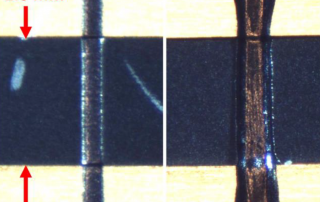
AEROSOL JET DIRECT WRITING POLYMER-THICK-FILM RESISTORS FOR PRINTED ELECTRONICS
Abstract To improve performance and reduce size of printed-circuit board (PCB) in electronics industry, embedding discrete components within a board substrate has been an effective approach by reducing solder joints and their associated impedance mismatching, inductive reactance, etc. With its unique capabilities for non-contact precision material deposition, the Aerosol Jet® direct-write technology has been enabling additive manufacturing of fine-feature electronics conformally onto flexible substrates of complicated shapes. The CAD/CAM controlled relative motions between substrate and print head allows convenient adjustment of the pattern and pile height of deposited material at a given ink volumetric deposition rate. To date in the printed [...]
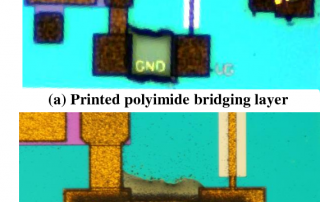
Aerosol Jet Printed Functional Nanoinks with High Reliability and Reconfigurability
ABSTRACT Printed electronic components have long been desired in the aerospace industry to enable prototyping, design verification, and concept validation of electronics at a much more rapid pace than photolithography or manual wire bonding processes. For satellites that are subjected to extreme thermal environments, highly reliable materials and processes are used. Aerosol jet printing has recently become more prevalent in commercial electronic manufacturing processes due to its consistency and fine feature size (<10 μm) when compared to other ink-based printing methods. Traditional conductive Ag and Cu inks produce printed materials that react under modest conditions, which degrades their electrical and [...]
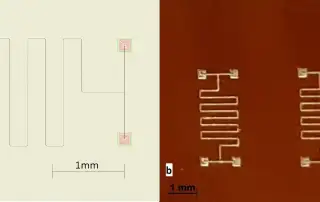
Highly conductive electronics circuits from aerosol jet printed silver inks
ABSTRACT Recently, low-cost electronics printed on lightweight, flexible and 3D shaped substrates are gaining importance in the markets of wearables and smart packaging. However, printed electronics do not meet the electrical performance of subtractive techniques because the resistivity of metallic printed patterns is still much higher than that of bulk material. To fulfil this need, low-resistive and easy printable inks for high resolution printed electronics techniques are needed. In this work, parameters of silver nanoparticles ink for micro-scale printed electronics technique, Aerosol Jet Printing, are being enhanced. To increase electrical conductivity and enhance printability, surfactants and dispersing agents were used [...]
Reuse of powder feedstock for directed energy deposition
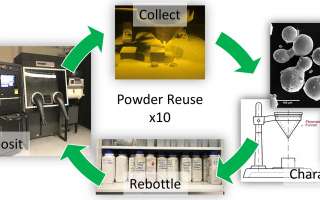
The deposition efficiency of metal based additive manufacturing processes, particularly with directed energy deposition (DED) equipment which requires powder feedstock, is often <50%. While reuse of the remaining powder is common in industry, the precise effects on build quality resulting from possible morphological, microstructural, and chemical changes in the powder remain poorly understood. In this study, the reuse of 316L stainless steel powder in the Laser Engineered Net Shaping (LENS®) machine was investigated through multiple deposition cycles. Particular attention was paid to the influence of reusing powder on: particle morphology, flowability, agglomeration, chemical composition and microstructure, via scanning electron microscopy, particle size analysis and mechanical testing of deposited parts [...]
Aerosol based direct-write micro-additive fabrication method for sub-mm 3D metal-dielectric structures
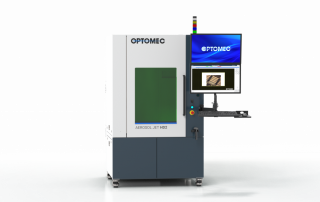
The fabrication of 3D metal-dielectric structures at sub-mm length scale is highly important in order to realize low-loss passives and GHz wavelength antennas with applications in wearable and Internet-of-Things (IoT) devices. The inherent 2D nature of lithographic processes severely limits the available manufacturing routes to fabricate 3D structures. Further, the lithographic processes are subtractive and require the use of environmentally harmful chemicals. In this letter, we demonstrate an additive manufacturing method to fabricate 3D metal-dielectric structures at sub-mm length scale. A UV curable dielectric is dispensed from an Aerosol Jet system at 10–100 µm length scale and instantaneously cured to build [...]
3D printed three-dimensional metallic microlattices with controlled and tunable mechanical properties
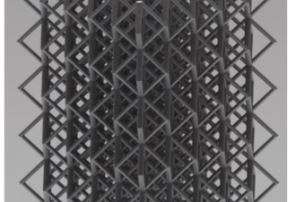
Three-dimensional metallic microlattice structures are critical for advancements in areas such as energy storage and conversion, high-sensitivity sensors, light-weight structures, bone implants, and high-efficiency catalysts. In this paper, Aerosol Jet 3D nanoparticle printing (Saleh et al., 2017) [23] is utilized to fabricate novel highly complex three dimensional (3D) metallic microlattice materials having near-solid truss members with diameters of 30–60 µm and unit sizes of 100–400 µm. Three types of lattice structures having densities from 5% to 26% of the bulk metal are designed to deform via bending-dominated and buckling-dominated mechanisms under compressive loads. The mechanical response of these microlattices could be tuned by changing [...]
Inkjet [Aerosol Jet] printing of oral dosage forms to solubilize BCS Class II drugs
Oral drug delivery remains the preferred method of administration but BCS Class II drugs are not ideally suited to this due to their inherent poor solubility. Although a number of methods to increase solubility already exist, there is a need for less damaging methods of production which are more flexible to the needs of the patient. The innovative formulation method of inkjet printing has been suggested for this purpose as it has the capacity to produce highly precise dosing in a continuous manner. The Optomec Aerosol Jet 200 Printer utilised in the current study has never been used in pharmaceutical [...]
Microstructure and Mechanical Properties of Heat-Treated Ti-Al-Si Alloy Produced via Laser In Situ Alloying
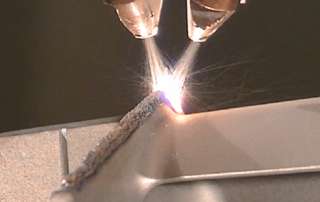
Intermetallics based on gamma titanium aluminide (γ-TiAl) alloys are potential lightweight materials that can be used for high-temperature components. However, poor room temperature ductility hinders their full potential for producing components using conventional manufacturing routes. This work is focused on the study of the microstructure and mechanical properties of ternary Ti-Al-Si alloy fabricated through laser in situ alloying by utilizing laser engineered net shaping (LENS) technology with subsequent heat treatment. The produced samples were analyzed using a scanning electron microscope (SEM) equipped with an energy-dispersed spectroscope (EDS) to investigate the composition and microstructure. Phase identification was investigated with x-ray diffraction (XRD) and electron [...]
Multi-layer Printing of Complex Antennas Using Aerosol Jet Technology
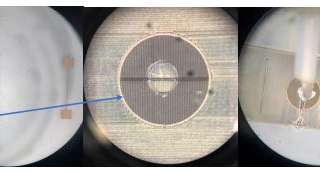
This project has demonstrated feasibility of producing multi-layer RF and microwave frequencycomponents using aerosol jet additive manufacturing technology. The effort focused on novel stackedcomponent designs for devices such as antennas, electronic filters, resistive/inductive/capacitive (RLC) components, and transmission lines. Our approach to RF/microwave component fabrication by aerosol jet printing has the potential to reduce component size, improve performance characteristics, and allow devices to be fabricated on non-planar surfaces. Specifically, folded micro-patch antenna designs were fabricated by stacking layers of conductors and dielectrics printed in sequence using Optomec’s aerosol jet technology. ORNL supported the effort by providing design input on printing parameters [...]