

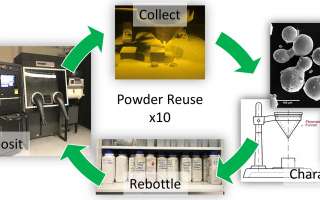
Reuse of powder feedstock for directed energy deposition
The deposition efficiency of metal based additive manufacturing processes, particularly with directed energy deposition (DED) equipment which requires powder feedstock, is often <50%. While reuse of the remaining powder is common in industry, the precise effects on build quality resulting from possible morphological, microstructural, and chemical changes in the powder remain poorly understood. In this study, the reuse of 316L stainless steel powder in the Laser Engineered Net Shaping (LENS®) machine was investigated through multiple deposition cycles. Particular attention was paid to the influence of reusing powder on: particle morphology, flowability, agglomeration, chemical composition and microstructure, via scanning electron microscopy, particle size analysis and mechanical testing of deposited parts [...]
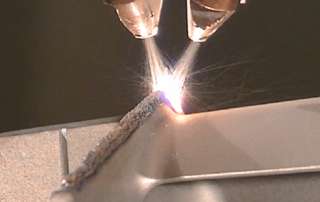
Microstructure and Mechanical Properties of Heat-Treated Ti-Al-Si Alloy Produced via Laser In Situ Alloying
Intermetallics based on gamma titanium aluminide (γ-TiAl) alloys are potential lightweight materials that can be used for high-temperature components. However, poor room temperature ductility hinders their full potential for producing components using conventional manufacturing routes. This work is focused on the study of the microstructure and mechanical properties of ternary Ti-Al-Si alloy fabricated through laser in situ alloying by utilizing laser engineered net shaping (LENS) technology with subsequent heat treatment. The produced samples were analyzed using a scanning electron microscope (SEM) equipped with an energy-dispersed spectroscope (EDS) to investigate the composition and microstructure. Phase identification was investigated with x-ray diffraction (XRD) and electron [...]

In-situ alloyed LENS additively manufactured TiAl-Nb structure
Titanium aluminides (TiAl) are interesting intermetallic materials to study due to their enhanced high temperature and light weight properties. They are necessary as structural materials, but brittle to form with conventional methods. Hence big corporates are interested in developments that will lead to cost effective manufacturing technologies that are able to produce homogenous, defect free TiAl structures. Additive manufacturing is one promising technology hence it was explored here in studying process development of producing TNB alloy using laser in-situ alloying approach. The produced alloy, -TNB, appeared to be homogeneous after heat-treatment and had hardness of 576HV.

Influence of in situ ceramic reinforcement towards tailoring titanium matrix composites using laser-based additive manufacturing
Increasing performance requirements of advanced components demands versatile fabrication techniques to meet application-specific needs. Composite material processing via laser-based additive manufacturing offers high processing-flexibility and limited tooling requirements to meet this need, but limited information exists on the processing-property relationships for these materials as well as how to exploit them for application-specific needs. In this study, Ti/B4C + BN composites are developed for high-temperature applications by designed-incorporation of ceramic reinforcement (5 wt% total) into commercially-pure titanium to form combined particle and in situ reinforcing phases. We combine both B4C (limited reactivity with matrix) and BN (high reactivity with matrix) reinforcements to understand the processing characteristics, in [...]
LENS manufactured γ-TNB turbine blade using Laser “in situ” alloying approach
A hollow γ-TNB turbine blade was 3D printed in this studying using the –R Optomec LENS machine from the elemental powders of aluminium, niobium and titanium making use of the laser “in situ” alloying approaching. The printed blade was characterised of a nearly lamellar β microstructure in the As-built state. The microstructure of the blade post heat treated was characterised of grain growth and coarsening and the formation of the γ phase which was of the result of the transformation of β. This transformation was also observed in the As-built state and is reported here for the first time. A [...]

3D spatial reconstruction of thermal characteristics in directed energy deposition through optical thermal imaging
A method to analyze and visualize thermal metrics extracted from coaxial thermal images collected during a 3D directed energy deposition is developed as a non-destructive means to assess thermally driven material characteristics and part quality. Standard practice for part qualification in additive manufacturing is through costly post-process non-destructive methods such as 3D digital computer tomography scans, or destructive cross sectional microstructure analysis. The extraction of thermal metrics throughout the build is useful for correlation to build characteristics such as defects or microstructure for process monitoring and control of additive manufacturing processes. The thermal metrics attained from the coaxial images in [...]

In-situ monitoring of melt pool images for porosity prediction in directed energy deposition processes
One major challenge of implementing Directed Energy Deposition (DED) Additive Manufacturing (AM) for production is the lack of understanding of its underlying process–structure–property relationship. Parts manufactured using the DED technologies may be too inconsistent and unreliable to meet the stringent requirements for many industrial applications. The objective of this research is to characterize the underlying thermo-physical dynamics of the DED process, captured by melt pool signals, and predict porosity during the build. Herein we propose a novel porosity prediction method based on the temperature distribution of the top surface of the melt pool as an AM part is being built. [...]

Predicting Part-Level Thermal History in Metal Additive Manufacturing Using Graph Theory: Experimental Validation With Directed Energy Deposition of Titanium Alloy Parts
The objective of this paper is to experimentally validate the graph-based approach that was advanced in our previous work for predicting the heat flux in metal additive manufactured parts. We realize this objective in the specific context of the directed energy deposition (DED) additive manufacturing process. Accordingly, titanium alloy (Ti6Al4V) test parts (cubes) measuring 12.7 mm × 12.7 mm × 12.7 mm were deposited using an Optomec hybrid DED system at the University of Nebraska-Lincoln (UNL). A total of six test parts were manufactured under varying process settings of laser power, material flow rate, layer thickness, scan velocity, and dwell [...]

Thermo-mechanical model development and validation of directed energy deposition additive manufacturing of Ti–6Al–4V
A thermo-mechanical model of directed energy deposition additive manufacturing of Ti–6Al–4V is developed using measurements of the surface convection generated by gasses flowing during the deposition. In directed energy deposition, material is injected into a melt pool that is traversed to fill in a cross-section of a part, building it layer-by-layer. This creates large thermal gradients that generate plastic deformation and residual stresses. Finite element analysis (FEA) is often used to study these phenomena using simple assumptions of the surface convection. This work proposes that a detailed knowledge of the surface heat transfer is required to produce more accurate FEA results. The surface convection generated by the deposition process is measured and implemented in the [...]
Sensing defects during directed-energy additive manufacturing of metal parts using optical emissions spectroscopy
Critical components produced via additive manufacturing must be free of unwanted defects. While defects may be detectable after deposition using nondestructive testing techniques, detecting defects during the deposition process offers many benefits: it may enable users to interrupt deposition to repair the part, or to abort deposition to minimize further loss of time and material. Here, we present a method for real-time defect detection during directed-energy additive manufacturing of metals. The method utilized optical emission spectroscopy and a custom-built data acquisition and control infrastructure. It was implemented on a LENS MR-7 machine, and employed during manufacturing of Ti-6Al-4V components in [...]